Over two thousand years ago, in the northeast reaches of ancient China, healers began fermenting tea into a tonic they called the "Immortal Health Elixir" — a living drink believed to restore balance to the body. Legend carried it to Japan, where a physician named Kombu brewed it for an ailing emperor and lent the drink his name. Traders carried it further still, along the Silk Road and into Russia and Eastern Europe, where nearly every household kept its own mother culture bubbling quietly on the counter — passed from grandmother to daughter, neighbour to neighbour, never sold, only shared.
It was never meant to be a product. It was meant to be a gift you gave the people you loved.
Our Family's Table 家的餐桌
That's exactly how it found us.
It started the way most good things in our family do — around a table too full of food, with too many voices talking over each other. Dinners, gatherings, weekend outings where nobody wanted to go home yet. Somewhere in the middle of all that noise and warmth, my aunties started brewing kombucha. Not for anyone but us.
They'd experiment — a jar steeped with lychee one week, dragonfruit the next, someone's leftover mangoes rescued from going soft. Every new batch got passed around the table like a rumour, everyone leaning in for a sip, arguing about whether this one needed more ginger or less sugar, whether the fizz was right. My mother got hooked first. Then, slowly, so did I.
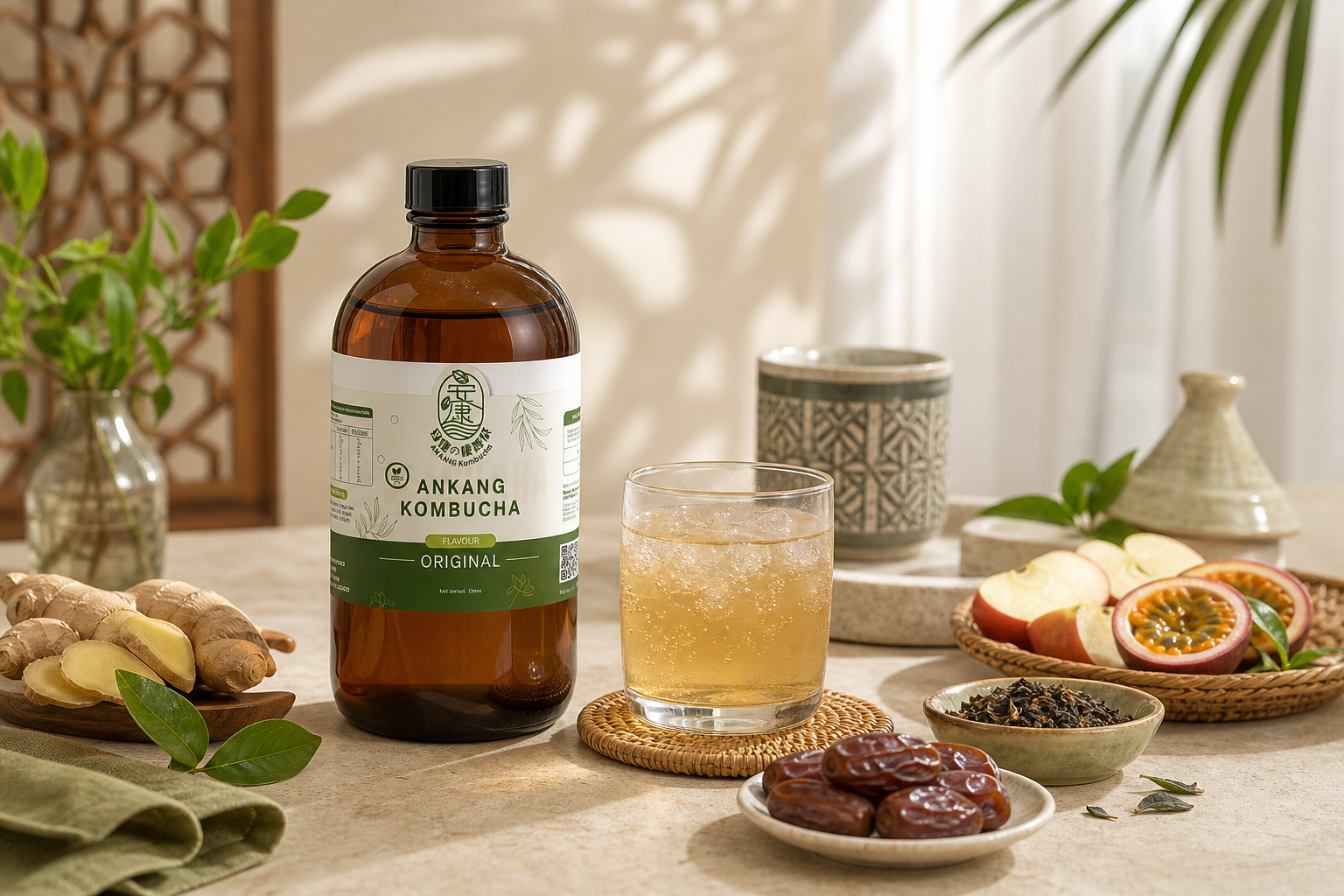
I didn't think much of it at the time — it was just what we did. But somewhere between all those tastings, I started asking questions. Where did this drink even come from? Why had my aunties, without ever calling themselves brewers, instinctively understood something people on the other side of the world had been doing for two millennia? I began digging into the history, then began making my own batches, and eventually found myself teaching friends how to grow their own SCOBY, how to hear when a ferment was ready, how something this old could still feel this new.
The Turning Point 转折点
What changed everything wasn't the flavour. It was the feeling.
Friends started telling me, almost sheepishly, that their digestion had never felt better. Clients I'd shared bottles with out of pure enthusiasm came back asking where they could buy more — not because I'd sold them anything, but because their bodies had noticed what their taste buds already loved. That was the moment it stopped being a hobby passed between family and friends, and started feeling like something worth sharing properly, carefully, with anyone willing to trust us with their gut health.
Why AnKang 为何安康
We named it AnKang — 安康 — an old Chinese wish for peace and wellbeing, the kind of thing you'd say to family as they left your table. It felt right, because that's exactly what this has always been: a family's care, bottled.
How We Brew 酿制之道
We brew the way my aunties taught themselves — by paying attention. Every utensil and bottle is sterilised before it ever touches a batch. We taste the first fermentation to know it's ready, then taste again after the second, chasing that precise moment where the tartness, the fizz, and the fruit all agree with each other. Every batch is supervised start to finish, by hand, because a living culture doesn't care about your production schedule — it tells you when it's ready, and we listen.
We will never mass-produce AnKang. Not because we can't, but because we won't trade the thing that made this drink worth sharing in the first place: a small batch, made with the same care my aunties poured into a jar on the kitchen counter, meant for people we wanted to see thrive.
Our Promise 我们的承诺
Every bottle of AnKang carries a family's dinner table into your hands — the arguments over flavour, the laughter, the two-thousand-year-old wisdom of a drink that was always meant to be shared, never sold cheap.